Harumi Klossowska de Rola – Hayawan
19 January – 26 February 2023
St. Moritz
Exhibition organised by Robilant+Voena
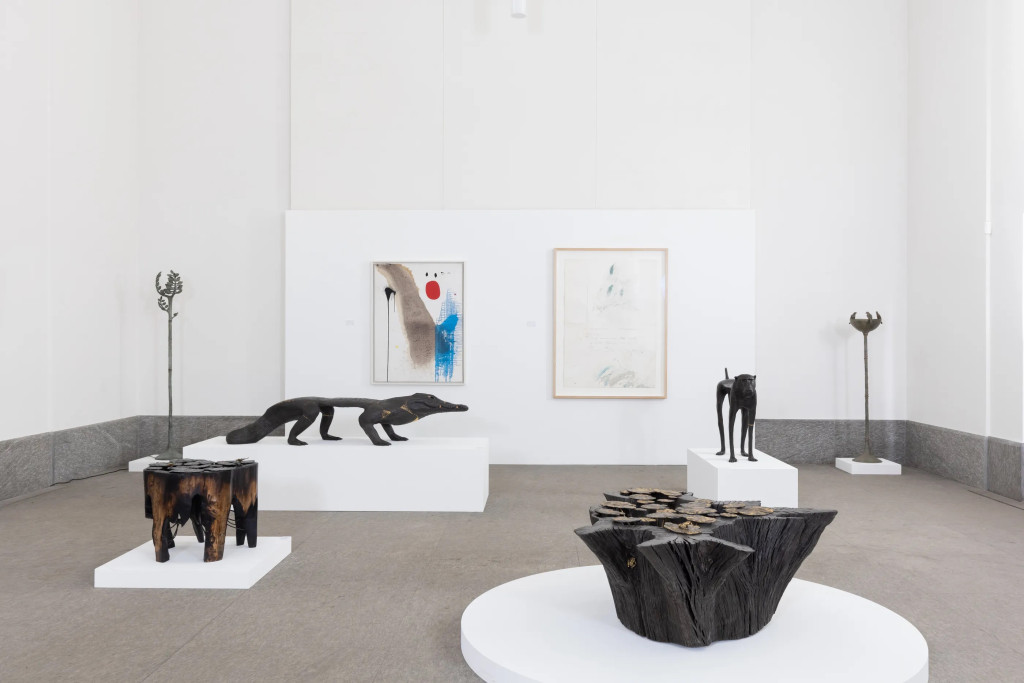
Harumi Klossowska de Rola is an artist and designer who makes sculptural works and finely crafted jewellery inspired by the flora and fauna of the natural world. Her first encounter with a collection of precious gems at the age of seven captivated her imagination and began a lasting fascination with jewels and the splendour of nature. Over the years she has developed a sensitive rendering of creatures great and small, often fusing the aesthetic with the functional and creating, in her words, “something that you can wear, or you can exhibit on a shelf”.
The exhibition brought together recent works inspired by ancient cultures and by the wild animals the artist encounters in the forests around her home in Switzerland. From bronze cheetahs to twisting trees detailed with small birds, Hayawan paid homage to the grace and form of the creatures that inhabit the earth, in works that recall the complexity of the animal kingdom.
Among the sculptures on display was Mafdet II, a cheetah cast in bronze with details in twenty-four carat gold. Inspired by the ancient Egyptian goddess associated with justice and protection, the sculpture appears to cry tears of gold, the gilding animating the head. Another of the works shown was a bench in the form of a crocodile, Sobek, named for the Egyptian god of the pharaoh’s power, of fertility and of military success, and gilded in twenty-four carat gold in a way that accentuates the weathered skin of the creature and underlines its association with the divine.
Plants and flora had a strong presence alongside the animals. The slender Ceres pays homage to the Roman goddess of agriculture in the form of a wheatsheaf, its stems opening outwards and reaching upwards. Tree with Single Bird is an example of the artist’s playful attentiveness to the natural world: the bird, almost invisible at first among the twisting branches and occasional leaf, is a tribute to the songbirds the artist hears in the forests around her home.
Together, the works evoked the sacredness and the beauty of the natural world. The animals of Harumi Klossowska de Rola are totemic entities which, as in shamanism, act as masters capable of building a bridge between nature and man, the visible and the invisible, the spirit and the earth.
TWENTIETH-CENTURY MASTERS
In conversation with these bronze creatures, the exhibition presented a selection of works by Chagall, Fontana, Miró, Morandi, Picasso and Twombly.
A Natura Morta of 1946 by Morandi offered a moment of reflection on a humble assortment of bottles and jars, and answered the plainness of the Protestant church in which it hung. This meditative still life was set against two canvases by Lucio Fontana from the Concetto Spaziale series, in which the artist opened the surface of the painting onto the space behind it. Both were made in 1964, one with a single slash and one with seven, and both demonstrate the capacity of the tagli to open horizons beyond the picture plane, which went on to occupy a generation of artists.
In Nu rose, Picasso treated the female form in his own manner, depicting his muse and second wife, Jacqueline Roque. Also on display was Joan Miró’s Paysage of 1974, a work that distils his perceptions into deliberately minimal forms and characterises the restraint of his late painting, with its interest in the power of emptiness and its calligraphic debt to Japanese art.
Made in the same year, Cy Twombly’s Untitled of 1974 exemplifies the artist’s expressionist handling, carrying his lifelong engagement with antiquity through an unorthodox approach to form and to the representation of language.
The presentation concluded with a late painting by Marc Chagall, Âne rouge au-dessous de la ville. Painted in old age and in retrospect, it stands as a testament to a lifetime.