Nero
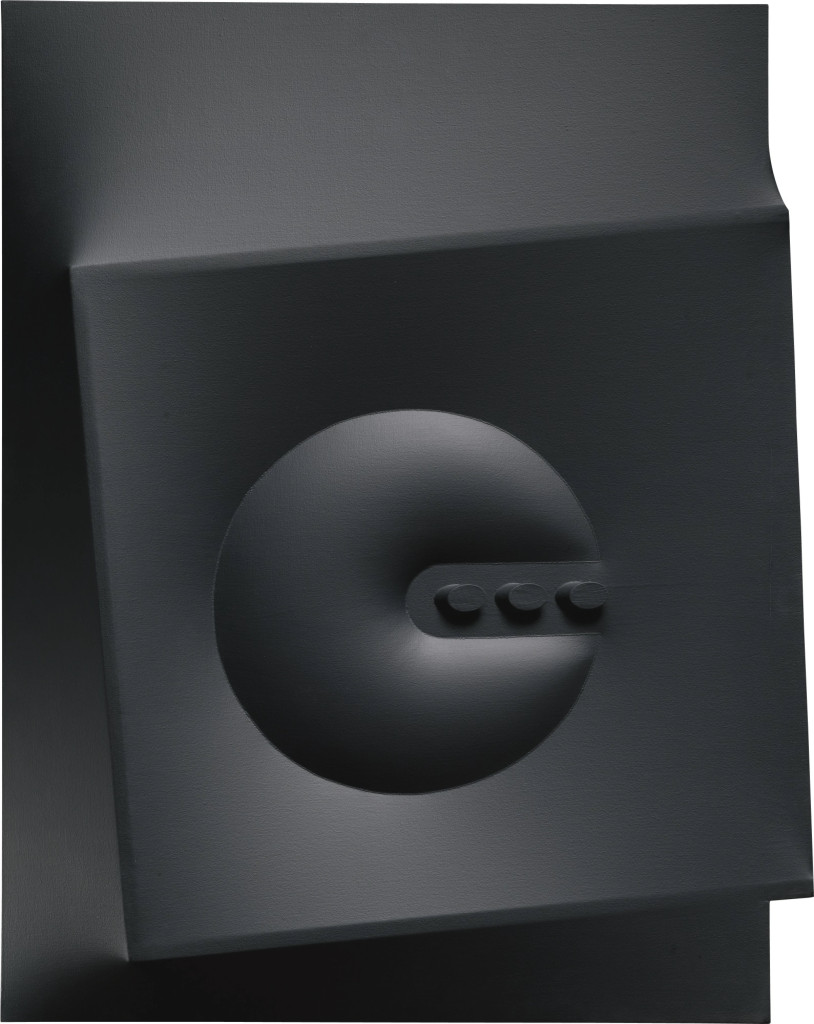
Date: 1966
Medium: Signed and dated 66 on the reverse, This work is registered in the Archivio Bonalumi, Milan, under the number 66-008 and is accompanied by a certificate of authenticity., Shaped canvas and vinyl tempera
Dimensions: 84 × 67 × 10 cm
Framed: 94.5 × 77 cm
Agostino Bonalumi was at the forefront of the exceptional wave of Italian artists who followed in the footsteps of Lucio Fontana in the late 1950s and 1960s. Inspired by Fontana’s spatial experiments with the canvas, Bonalumi had begun working with Enrico Castellani and Piero Manzoni as early as 1958, and by the mid-1960s his reputation was rising both at home and internationally, with strong links to the Zero artists in Germany and with critics in Italy beginning to recognise his importance; in 1966 he was invited to take part in the Venice Biennale for the first time. His signature works are the estroflessioni, in which monochrome canvases are stretched and deformed from behind to create abstract forms, pushing the picture plane into three dimensions so that the paintings become sculptures, or what the critic Gillo Dorfles called pittura-oggetto, painting-object. Alongside Fontana with his knife, Burri with his blowtorch, and Castellani, who hammered nails into the reverse of his surfaces, Bonalumi was part of a fundamental redefinition of painting in which the pictorial plane had become what the American critic Harold Rosenberg called “an arena in which to act.”
Nero dates from 1966, the year of that first Biennale invitation, and shows the idea at its most concentrated. The canvas is an upright rectangle left plain across most of its area, so that everything happens in a single circular swelling at its centre, out of whose flank three short bars emerge in a row. Nothing has been applied to the surface and nothing carved out of it, since the whole relief is the canvas itself, lifted off the plane by an armature behind and held there under tension, which is why the forms read as at once wholly physical and strangely weightless. At its deepest the work stands ten centimetres clear of the wall, far enough to be a shallow sculpture by any ordinary measure while remaining, in every material respect, a painting.
The black does the rest, since vinyl tempera in a single matt tone gives the eye no colour to settle on and the work is therefore read almost entirely by light, the dome catching its brightest value at the crown and falling away through a long gradation into shadow at the lower edge while the three bars throw small, hard shadows of their own against it. The painting alters through the day and alters again as the viewer moves across it, which is the point of it: Bonalumi is not depicting a volume but producing one, and asking light rather than pigment to do the describing.
The work is signed and dated 66 on the reverse, is registered at the Archivio Bonalumi, Milan, under number 66-008, and is accompanied by a certificate of authenticity.
Provenance
Bruno Pellicani Collection, Brugherio
Sale: Dorotheum, Zeitgenossische Kunst, 19 May 2010, Lot 454
Acquired directly from the above by the previous owner
Sothebys, London Oct 17th 2014 Lot no 6
Exhibited
Milan, Galleria del naviglio, Agostino Bonalumi, 1968
Darmstadt, Institut Mathildenhohe, Agostino Bonalumi, 2003 p 118 illustrated (incorrectly dated)
Shown at VOENA
- Frieze Abu Dhabi, 19 – 22 November, Manarat Al Saadiyat, Abu Dhabi